 By Peter Waddell
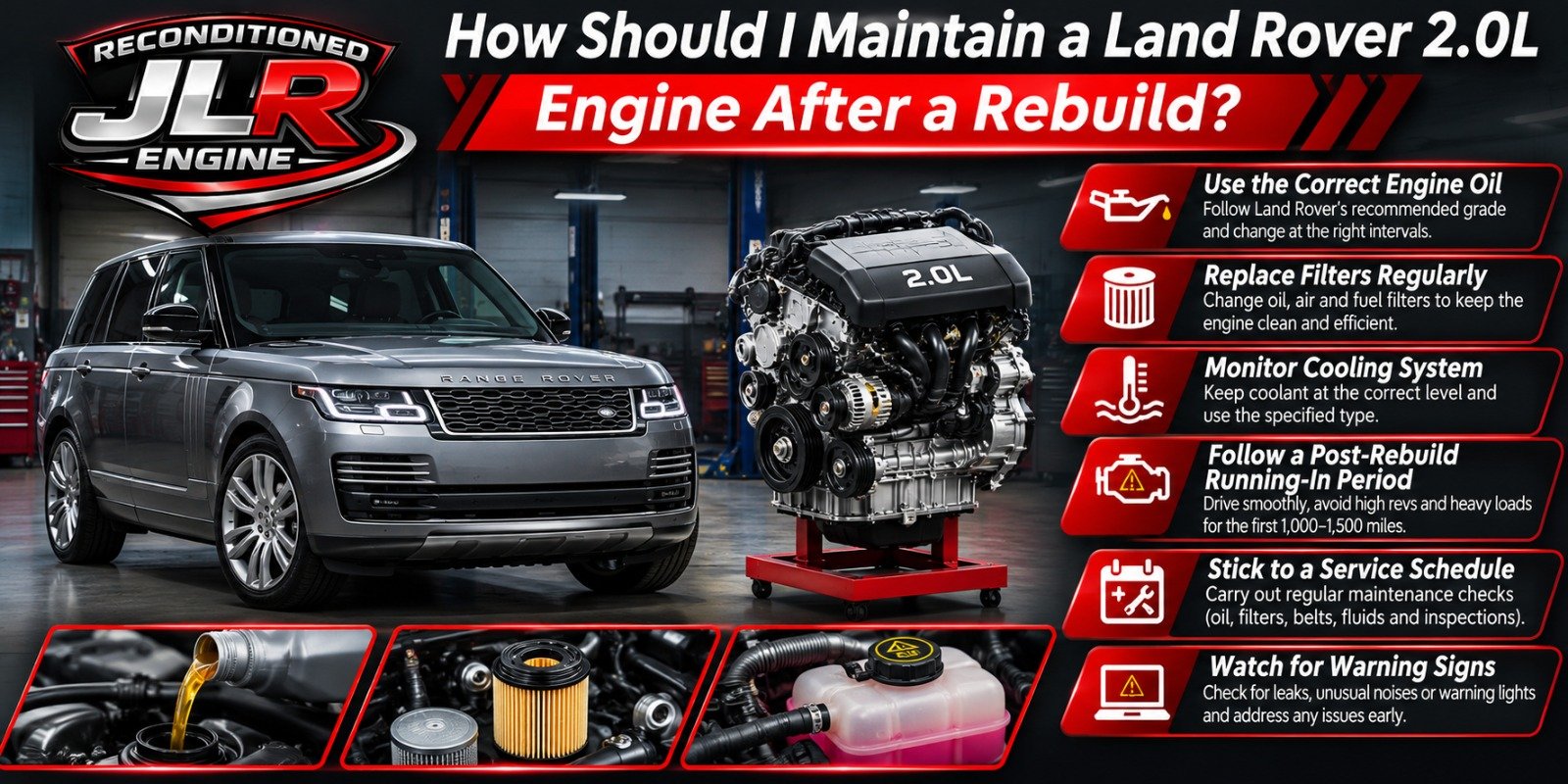
A freshly rebuilt engine is a clean slate. Every bearing, ring and timing chain inside it is new, so it has thousands of trouble-free miles ahead. However, those miles are not automatic. What you do in the first few weeks, and every month after, decides how long the engine really lasts. The good news? Land Rover 2.0 engine maintenance is not complicated. In this guide, the team at Reconditioned JLR Engine in Grays shares the exact routine we give our own customers. Follow it, and your engine will reward you for years.
1. The First 1,000 Miles: Running In Your Land Rover 2.0 Engine
New piston rings need time to bed into the cylinder walls. During this period, gentle driving helps them seal properly. Rush it, and you risk higher oil use for the rest of the engine’s life.
Here is a simple running-in timeline:
- Day one: let the engine idle for a few minutes before you drive. Then check under the bonnet for leaks.
- First 50 miles: keep journeys smooth and avoid hard acceleration. Vary your speed rather than holding one steady speed.
- 50 to 500 miles: keep revs below about 3,000 rpm. Avoid towing and full-throttle overtakes.
- 500 to 1,000 miles: slowly build up to normal driving. Short bursts of extra revs are fine now.
- At 1,000 miles: book your first oil and filter change. This step is vital, because it flushes out tiny particles from the new parts.
Also, check your oil level every week during this period. A little use is normal while the rings bed in. However, sudden drops are worth a quick call to your engine builder. In short, patience now pays off with a stronger, cleaner-running engine later.
2. Oil, Coolant and Filters: Your Post-Rebuild Service Plan
After the running-in period, regular servicing becomes your engine’s best friend. Ingenium engines are especially sensitive to oil quality, because their timing chains rely on clean, healthy oil.
| Task | When to Do It | Why It Matters |
| First oil and filter change | 1,000 miles | Removes running-in particles |
| Second oil and filter change | 5,000 miles | Clears any remaining debris |
| Regular oil and filter change | Every 6,000–9,000 miles or 12 months | Protects the timing chain and bearings |
| Oil level check | Every 2 weeks | Spots oil use or dilution early |
| Coolant level and condition | Monthly | Prevents overheating and head damage |
| Air filter | Every 12,000–18,000 miles | Keeps the engine breathing freely |
| Fuel filter (diesel) | Every 24,000–36,000 miles | Protects the injectors |
Notice that these intervals are shorter than the long gaps in some factory schedules. That is deliberate. Long oil change intervals are a major reason why the Land Rover 2.0 engine suffers timing chain stretch in the first place. Also, always use the exact JLR oil specification listed in your handbook. The wrong grade can starve the chain and turbo of protection.
3. Land Rover 2.0 Engine Codes, Specs and What Each One Needs
Every version of the Land Rover 2.0 engine has slightly different care needs. Diesels need attention to the DPF and oil dilution. Petrols need clean oil for their turbo and timing chain. Hybrids add battery and cooling checks.
| Engine | Code | Fuel | Power | Torque | Found In | Main Maintenance Focus |
| 2.0 Si4 | 204PT | Petrol | 240PS | 340Nm | Freelander 2, Discovery Sport | Turbo oil supply, spark plugs |
| 2.0 TD4 Ingenium | 204DTD | Diesel | 150–180PS | 380–430Nm | Discovery Sport, Discovery 5, Evoque, Velar | Oil dilution, DPF health |
| 2.0 SD4 / D240 | 204DTA | Diesel | 200–240PS | 430–500Nm | Discovery Sport, Discovery 5, Defender | Twin-turbo oil feed, DPF |
| 2.0 D165 / D200 MHEV | 204DTD (MHEV) | Diesel Hybrid | 163–204PS | 380–430Nm | Discovery Sport, Evoque | Oil level, 48V system checks |
| 2.0 P200–P300 | PT204 | Petrol | 200–300PS | 320–400Nm | Discovery Sport, Discovery 5, Defender, Evoque | Timing chain oil, coolant |
| 2.0 P400e PHEV | PT204 + e-motor | Petrol Hybrid | 404PS (combined) | 640Nm | Defender, Range Rover Sport | Battery cooling, regular engine use |
One tip for plug-in hybrid owners: let the petrol engine run regularly. If it sits unused for weeks, the oil cannot protect the internals properly. Not sure which code your vehicle has? Send us your registration, and we will tell you.
4. Everyday Habits That Protect a Rebuilt Engine
Servicing matters, but daily driving habits matter just as much. A few simple changes can add years to your rebuilt engine.
Warm it up gently. Avoid high revs until the temperature gauge reaches normal. Cold oil is thick and cannot protect the bearings fully.
Take a longer drive regularly. Short trips are hard on diesel engines. The DPF needs a steady 20 to 30-minute run to clean itself. If it cannot, extra fuel washes into the oil. As a result, the oil thins and the timing chain wears faster.
Let the turbo cool. After a hard drive or towing, idle for 30 seconds before switching off.
Use quality fuel and AdBlue. Cheap or contaminated fluids can damage injectors and emissions parts.
Watch for warning signs. Call a specialist straight away if you notice:
- a rattle on cold start
- a rising oil level on the dipstick
- new smoke from the exhaust
- coolant loss
- a sudden drop in power
Catching problems early is always cheaper than a second engine replacement. Treat these habits as part of your engine’s warranty, because in many ways, they are.
5. Real Engine Work, Real Specialist Support
At Reconditioned JLR Engine, our relationship with you does not end when you drive away. In fact, we see the first few months as the most important part of the job.
Every customer leaves with a printed running-in guide. We also log your mileage and send a reminder when your first oil change is due. If you are local, you can book that service at our Land Rover Garage in Grays. If not, we will tell your own garage exactly what oil and filter to use.
Have a question at 500 miles? Just call. A real technician will pick up, not a call centre. Maybe the oil level looks slightly low, or the engine sounds different on a cold morning. We would rather you ask than worry.
We also explain the reason behind each step. For example, we will show you why short trips harm a diesel engine. Understanding the “why” makes good habits much easier to keep. In short, real support means honest advice whenever you need it, for as long as you own the engine.
6. UK’s No.1 Engine Reconditioners
Good maintenance works best on a well-built engine. That is why the quality of the rebuild matters so much. At our Land Rover Engine Works in Grays, we build every engine with long-term care in mind.
Each unit is stripped, cleaned, measured and machined to factory limits. Then we fit new rings, bearings, seals and a complete timing chain kit. We also flush the oil cooler and check the EGR cooler, so old contamination cannot attack the new parts.
This is also where reconditioned engines vs used engines really differ. A used engine arrives with unknown wear, so even perfect servicing cannot undo past neglect. In contrast, reconditioned engines start fresh. Your maintenance protects new parts instead of trying to rescue old ones.
What about cost? As a guide, engine replacement costs in UK garages for a reconditioned Land Rover 2.0 engine sit around £3,500 to £6,500 supplied and fitted. Hybrid versions cost a little more. By comparison, regular oil changes cost very little. So, a simple service routine is the cheapest insurance you can buy.
7. Nationwide Vehicle Recovery
Our recovery and logistics service supports you before, during and after your engine rebuild. Wherever you are in the UK, getting your vehicle to us is easy.
If your Land Rover breaks down, we arrange collection from your home, office or roadside. A trained driver brings it to our Grays workshop on a covered transporter. Then, once the work is done, we bring it straight back to you.
Some owners choose to have their engine fitted locally. In that case, we deliver the engine to their chosen garage, securely mounted on a pallet and tracked throughout. We even include our running-in guide in the delivery, so your mechanic knows our recommendations.
What if something feels wrong during the running-in period? Do not drive on and hope. Call us, and we can arrange collection for a free health check. This way, small concerns never turn into big problems. Whether you live in Kent, Leeds or the Scottish Highlands, the same service applies.
8. Why Choose Our Engines?
When you shop for a Land Rover engine for sale, look beyond the price tag. Think about who will support you after the sale. Here is what you get when you buy from us:
- No Upfront Charges: you pay nothing until the work is complete.
- No Deposit Required: your money stays with you until your vehicle is ready.
- Aftercare included: a running-in guide, service reminders and phone support.
- New timing chain kit as standard: fitted to every 2.0 Ingenium engine rebuild.
- Root cause fixed: we tackle the EGR cooler, oil cooler or DPF issue behind the failure.
- Written warranty: clear cover, explained in plain English.
Our supply and fit services keep everything under one roof. We diagnose the fault, give you a fixed quote, rebuild or supply the engine, then fit it and code it. Finally, we road test your vehicle and hand you a simple care plan.
So, if you are ready to give your Land Rover a fresh start, contact our team today. Then follow our Land Rover 2.0 engine maintenance plan and enjoy many reliable miles ahead.
Frequently Asked Questions
1. How long is the running-in period for a rebuilt Land Rover 2.0 engine?
Plan for around 1,000 miles of gentle driving. After that, change the oil and filter, then build up to normal use.
2. How often should I change the oil after a rebuild?
Change it at 1,000 miles, again at 5,000 miles, then every 6,000 to 9,000 miles. Shorter intervals help protect the timing chain.
3. Are short trips bad for my rebuilt diesel engine?
Yes, if they happen all the time. Regular longer drives help the DPF clean itself and stop fuel thinning the oil.
4. Do I need to pay anything before my engine is fitted?
No. We offer No Upfront Charges and No Deposit Required, so you pay only when the job is finished.
5. What should I do if my oil level rises after the rebuild?
Contact us straight away. A rising oil level on a diesel often means fuel dilution, which needs checking quickly.