 By Peter Waddell
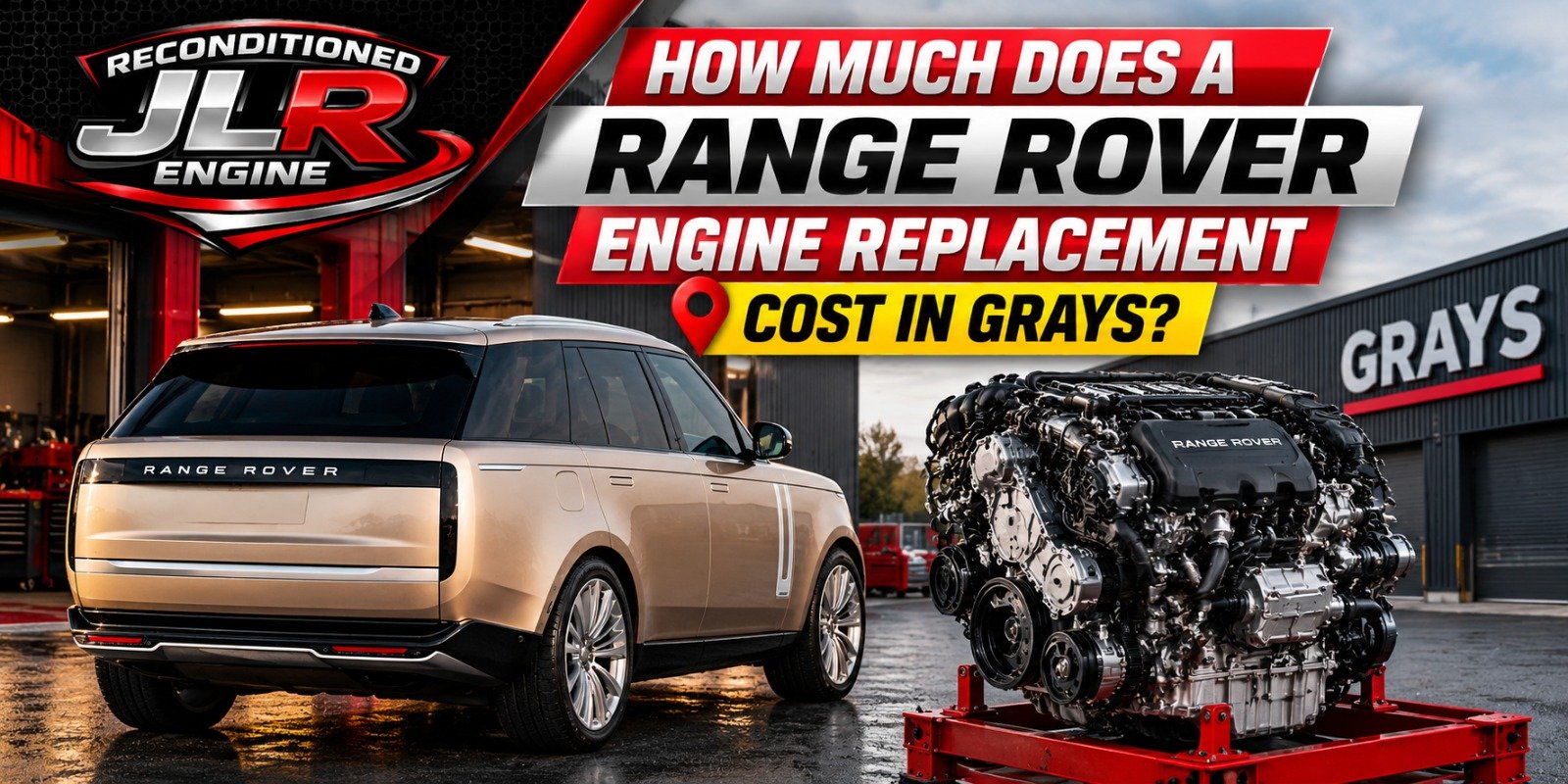
If you need a Range Rover engine replacement in Grays, cost is usually your first concern. A main dealer can charge a very high price for a new engine. Fortunately, there are reliable alternatives, such as reconditioned engines and a professional engine rebuild. At Reconditioned JLR Engine, our Grays workshop specialises in Range Rover engines. In this guide, we explain engine replacement costs in the UK, engine codes, specifications, our supply and fit services and nationwide logistics.
Why Choose a Specialist Range Rover Garage in Grays?
A Range Rover is a complex, high-value vehicle, so it needs specialist care. A general workshop may not have the right diagnostic tools or experience with Land Rover engines. A dedicated Range Rover garage, on the other hand, knows each engine’s common faults and how to fix them properly.
At Reconditioned JLR Engine, we work only on Jaguar and Land Rover vehicles. As a result, our technicians deal with Range Rover engines every single day. We use JLR-level diagnostic equipment to find the real cause of failure. In addition, we can code new engines and modules to your vehicle in-house.
Our Grays location is also convenient for drivers across Essex, London and the South East. We’re close to the M25 and A13, so dropping off your car is quick and easy.
Most importantly, choosing a specialist usually saves money. Faults are fixed correctly the first time, so you avoid repeat repairs. That’s why many Range Rover owners choose our Range Rover Engine Works over main dealers for engine replacement in Grays.
Range Rover Engine Codes and Model Table
Before you buy any Range Rover engine for sale, you need to know the correct engine code. Range Rover has used many diesel and petrol engines over the years. The table below shows the most common ones.
| Engine | Models | Years | Engine Code | Size | Power | Torque |
| TDV6 | Range Rover / Sport | 2013–2018 | 306DT | 3.0 L V6 diesel | 258 PS | 600 Nm |
| SDV6 | Range Rover / Sport | 2013–2018 | 306DT | 3.0 L V6 diesel | 306 PS | 700 Nm |
| SDV8 | Range Rover / Sport | 2013–2021 | 448DT | 4.4 L V8 diesel | 339 PS | 740 Nm |
| SD4 / D240 | Sport / Velar | 2016–2020 | 204DTA | 2.0 L I4 diesel | 240 PS | 500 Nm |
| D300 / D350 MHEV | Range Rover / Sport | 2020–present | DT306 | 3.0 L I6 diesel | 300–350 PS | 650–700 Nm |
| P400 MHEV | Range Rover / Sport / Velar | 2019–present | PT306 | 3.0 L I6 petrol | 400 PS | 550 Nm |
| P400e PHEV | Range Rover / Sport | 2018–2022 | PT204 | 2.0 L I4 + motor | 404 PS | 640 Nm |
| 5.0 V8 Supercharged | Range Rover / Sport | 2009–2022 | 508PS (AJ133) | 5.0 L V8 petrol | 510–575 PS | 625–700 Nm |
| P530 V8 | Range Rover L460 / Sport L461 | 2022–present | BMW-sourced (N63/S68) | 4.4 L V8 petrol | 530 PS | 750 Nm |
Even when models share an engine code, the sumps, wiring and ancillaries can differ. For that reason, we always check your VIN before supplying any engine.
Range Rover Engine Specifications
Knowing your engine’s specification helps you choose the right replacement. Here are the key specs for three of the most popular Range Rover engines.
3.0 TDV6 / SDV6 (306DT)
- Layout: 60° V6, 24 valves
- Displacement: 2,993 cc
- Bore x stroke: 84.0 mm x 90.0 mm
- Compression ratio: 16.1:1
- Induction: Single turbo (TDV6) or twin turbo (SDV6)
- Block: Compacted graphite iron
4.4 SDV8 (448DT)
- Layout: 90° V8, 32 valves
- Displacement: 4,367 cc
- Bore x stroke: 84.0 mm x 98.5 mm
- Compression ratio: 16.1:1
- Induction: Twin sequential turbochargers
5.0 V8 Supercharged (508PS / AJ133)
- Layout: 90° V8, 32 valves
- Displacement: 4,999 cc
- Bore x stroke: 92.5 mm x 93.0 mm
- Compression ratio: 9.5:1
- Induction: Twin-vortex Roots-type supercharger
Each engine has known weak points. On the 3.0 V6 diesels, for example, crankshaft and bearing failure is common. The 5.0 V8, meanwhile, can suffer from timing chain and water pump problems. A specialist rebuild fixes these issues at the root.
How Much Does a Range Rover Engine Replacement Cost in Grays?
Engine replacement costs depend on the engine type and the option you choose. As a rough guide, a reconditioned Range Rover engine supplied and fitted at our Grays workshop costs:
- 2.0 Ingenium diesel (204DTA): around £3,500 to £5,500
- 3.0 TDV6 / SDV6 (306DT): around £4,000 to £6,500
- 4.4 SDV8 (448DT): around £6,500 to £10,000
- 5.0 V8 Supercharged (508PS): around £6,000 to £9,500
- 3.0 Ingenium I6 (DT306 / PT306): around £6,000 to £9,000
By comparison, a brand-new engine from a main dealer can cost £15,000 to £25,000 or more. As a result, a reconditioned engine can save you thousands of pounds.
These prices are only a guide. Your final cost depends on your model, mileage and any extra parts needed, such as turbos, injectors or a water pump. For that reason, we always give a fixed, itemised quote before any work begins. That way, you know exactly what you’ll pay, with no hidden extras.
What Affects Engine Replacement Costs in the UK?
Engine replacement costs in the UK vary for several reasons. Understanding them helps you compare quotes fairly.
1. Engine type. A V8 costs more to source and fit than a four-cylinder engine.
2. New, used or reconditioned. New engines cost the most. Used engines are cheapest but riskier, while reconditioned engines offer the best value.
3. Extra parts. Turbochargers, injectors, the DPF and cooling parts may also need replacing. If the old engine failed badly, debris can damage these parts too.
4. Cause of failure. The original cause must be fixed, such as an oil supply problem or overheating. Otherwise, the new engine could fail as well.
5. Labour time. Some Range Rover models take longer to work on. For example, many need the body lifted off the chassis to remove the engine.
6. Garage type. Main dealers usually charge higher hourly rates than an independent Range Rover garage.
In short, a detailed quote from a specialist gives you the clearest and fairest price for your engine replacement.
Reconditioned Engines vs Used Engines
When comparing reconditioned engines vs used engines, the biggest differences are reliability and warranty. A used engine comes straight from a donor vehicle. Its history is often unknown, and worn parts stay inside. Therefore, it may fail soon after fitting.
Reconditioned engines, by contrast, are fully stripped, cleaned and inspected. We replace worn parts such as bearings, piston rings, timing chains, seals and gaskets with new ones. Next, we machine the crankshaft and cylinder head where needed. Finally, every engine is rebuilt to factory tolerances and tested before it leaves our workshop.
For Range Rover engines, this process matters a great deal. Known problems, such as crankshaft failure on the 3.0 diesel, are fixed properly during reconditioning. A used engine may already carry the same fault.
Although a used engine may seem cheaper at first, it rarely comes with a solid warranty. A reconditioned engine, on the other hand, gives you near-new reliability at a fair price. That’s why most of our customers choose to shop for reconditioned rather than used.
Engine Rebuild and Supply and Fit Services With No Upfront Charges
Sometimes your existing engine can be repaired instead of replaced. An engine rebuild works well when the block and crankshaft are still in good condition. If the damage is severe, however, a reconditioned replacement is usually faster and better value. Our team will inspect your engine and explain both options clearly.
Our supply and fit services cover the whole job. First, we source the correct engine for your VIN. Then our Range Rover Engine Works team fits it in Grays with new oil, filters, coolant and gaskets. After that, we code the engine to your vehicle and road-test it before handover.
Best of all, we offer No Upfront Charges and No Deposit Required. You only pay once the job is complete and you’re fully satisfied. This removes the risk from a big repair.
Every engine also comes with a warranty for extra peace of mind. If you’re ready to buy a reconditioned Range Rover engine with expert fitting, contact Reconditioned JLR Engine today for a free, no-obligation quote.
UK-Wide Logistics and Delivery From Grays
Although our workshop is in Grays, Essex, we serve customers across the whole UK. Our logistics service makes engine replacement easy, wherever you are.
If your Range Rover can’t be driven, we can arrange vehicle recovery to our workshop from England, Scotland and Wales. Once the work is finished, we can then return the vehicle to your home or business. Alternatively, if you prefer to use your local garage, we can deliver the engine straight to them.
Every engine is secured to a pallet, sealed against dirt and moisture, and shipped with a trusted courier. In addition, you get tracking updates from dispatch to delivery, so you always know when it will arrive.
Grays sits close to the M25, A13 and Port of Tilbury. As a result, we can move engines quickly to London, Essex, Kent and the rest of the country. Next-day delivery is available on most stock engines. Simply put, you can shop with us online or by phone, and we’ll handle the rest.
Frequently Asked Questions
1. How much does a Range Rover engine replacement cost in Grays?
A reconditioned engine supplied and fitted usually costs between £3,500 and £10,000, depending on the engine. We provide a fixed quote before starting any work.
2. How long does a Range Rover engine replacement take?
Most replacements take 3 to 7 working days, depending on the model and parts availability. We keep you updated throughout the job.
3. How do I find my Range Rover engine code?
You can find it on your V5C, service records or the engine block itself. Alternatively, send us your VIN and we’ll confirm it for you.
4. Do I need to pay a deposit?
No. We offer No Upfront Charges and No Deposit Required, and you only pay once the work is complete.
5. Can you collect my Range Rover if it’s not drivable?
Yes. We offer UK-wide vehicle recovery to our Grays workshop and can return the car once the work is complete.